
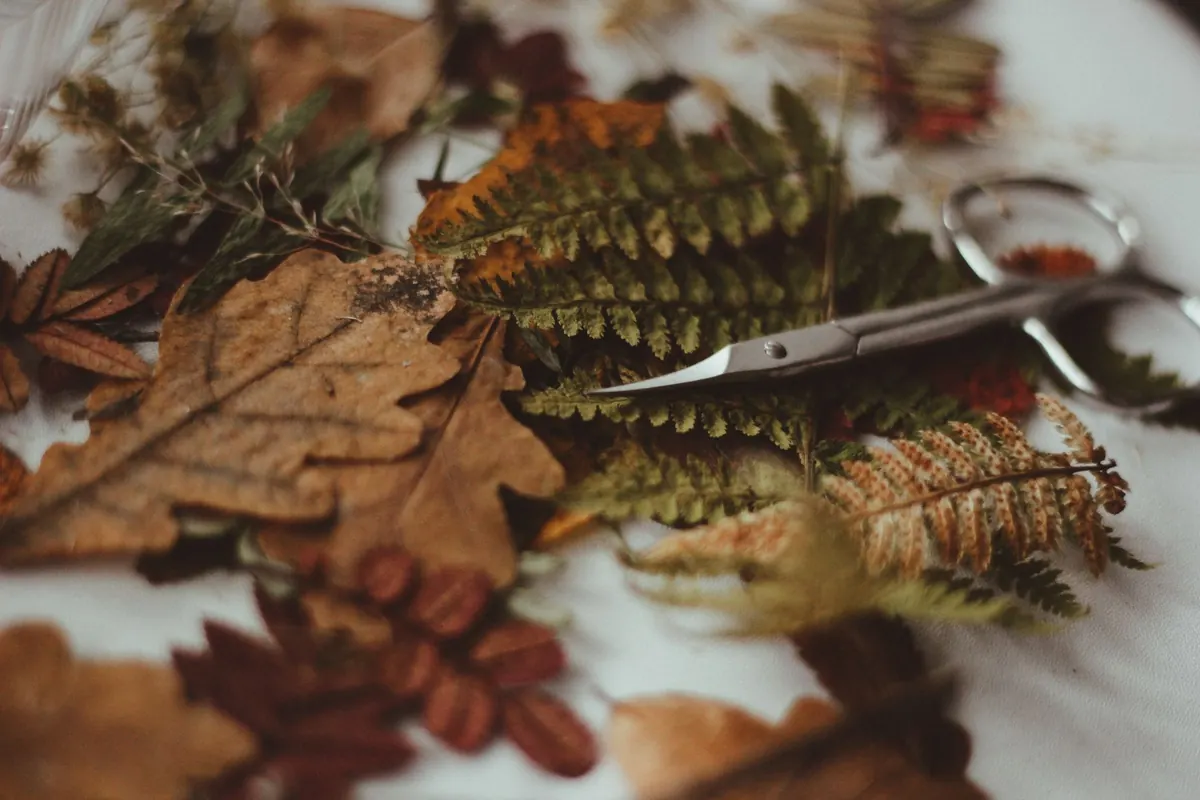
There is a short window each autumn when the ground underfoot is more interesting than anything on a craft shop shelf. Beech turns copper, oak goes rust, and sweet chestnut leaves dry into something closer to leather. Gather a bagful on a dry afternoon and you have the raw material for a garland that costs almost nothing and looks far better than its price suggests.
It is also a genuinely all-ages project. Small children can hunt and sort; older ones can handle the iron and the needle; adults can fuss over arrangement. The only real enemy is damp, so pick a dry day and leave anything soggy or spotted behind.
Choosing Leaves Worth Keeping
Not every leaf survives the process. Look for leaves that have fallen recently and feel dry to the touch, with their stems still attached. Stems matter more than people expect — they give you something to sew through or bind around, and a leaf without one has to be glued instead.
Reliable candidates:
- Oak — sturdy and deeply lobed, holds its shape well
- Beech — smooth, warm copper, presses beautifully
- Maple and sycamore — thin and flat, ideal for wax sealing
- Birch — small and delicate, lovely in clusters
- Sweet chestnut — long and toothed, dries like leather
- Horse chestnut — dramatic, but the leaves often curl as they dry
Skip anything with black spots, slime or a musty smell. Skip fresh green leaves still on the tree, too: they hold too much moisture and will shrink and brown unevenly once picked.
Three Ways to Preserve Autumn Leaves
Pressing
The oldest method and still the most reliable for flat leaves. Sandwich them between sheets of newspaper, then layer between heavy books or under a board with weight on top. Leave for one to two weeks, changing the newspaper after the first couple of days if it feels damp. Pressed leaves are flat, matte and slightly brittle — perfect for gluing, less good for threading.
Glycerine
Glycerine keeps leaves supple rather than crisp, which makes them much easier to work with on a garland. Mix one part glycerine to two parts hot water in a shallow tray, lay the leaves in, and weigh them down with a plate so they stay submerged. Thin leaves may be ready in a few days; thicker ones can take a fortnight. They are done when the whole leaf has darkened to a soft olive-brown and feels leathery. Blot them dry and they will stay flexible for months. Glycerine is sold in most pharmacies.
Wax or glue sealing
Lay a leaf on a sheet of wax paper, cover with a second sheet, and iron on a low setting with no steam, moving the iron constantly. The wax melts and traps the leaf. Alternatively, brush both sides with PVA glue diluted with a little water. It dries clear and slightly glossy, which suits firmer leaves, and a coat of beeswax polish gives a softer sheen.
What You Will Need
- 30–50 preserved leaves, roughly similar in size
- 2–3 metres of jute twine, ribbon or narrow hessian
- PVA glue, a glue gun, or a needle and strong thread
- Small pegs or paper clips to hold pieces while glue dries
- Optional extras: dried orange slices, cinnamon sticks, small pinecones, acorns
Assembling the Garland
- Lay the leaves out in a line on the floor or a long table, overlapping them slightly like roof tiles. Move them about before you commit to anything — the arrangement is the part that makes it look deliberate rather than accidental.
- Cut your twine to length, plus a generous extra at each end for hanging loops. Measure the mantelpiece, shelf or doorway first. A garland that comes up short is a genuine annoyance.
- Choose your fixing method. The simplest for children is glue: run a line of PVA along the twine and press leaves on in overlapping pairs, sandwiching the string between two leaves so it disappears. Hold each pair with a peg for a few minutes.
- For something that will last several years, sew through the stem or the base of each leaf with a needle and strong thread, knotting as you go. Slower, but it survives being taken down and put back up.
- Tuck in the extras: a cinnamon stick between leaves, a dried orange slice threaded onto the twine, a pinecone wired at each end.
- Leave the whole thing flat to dry overnight. Fresh glue plus gravity equals a sagging garland.
- Hang it with small hooks or drawing pins along a shelf, across a window or over a doorframe.
Two practical notes: an adult should handle the iron and the glue gun, and anyone using a scalpel or wire cutters should work on a cutting mat rather than the kitchen table.
Variations Worth Trying
- A single-leaf garland — all beech, all oak — for a quieter, more formal look
- Alternate leaves with dried orange slices for colour and a faint citrus scent
- Cut felt leaves for very young children to thread onto a blunt needle and yarn
- Space leaves further apart along a length of rope for a looser, more rustic swag
- Add a few sprigs of dried rosemary or seed heads from the garden
Hanging, Storing and Making It Last
Keep the garland away from damp and out of strong direct sunlight. A steamy kitchen windowsill is the worst place for it; a hallway, a bedroom shelf or above a fireplace that sits unused for most of the day are all kinder. If the leaves start to curl at the edges, a light mist of water and a gentle press under a book will flatten them again.
At the end of the season, wrap the garland loosely in tissue paper, lay it in a shallow box and store it somewhere dry. Don't pile anything on top. Expect the colours to soften over the years — pressed leaves fade towards brown and grey, and that muted look has its own charm. If a leaf comes loose, a dot of PVA will put it right.
A Job for the Whole Table
Set this up as a table project rather than a solo one. Put out trays of sorted leaves, a pot of glue, a bowl of pegs and a bin bag for the offcuts, and let everyone take a section of twine. Someone sorts, someone glues, someone decides where the orange slices go.
The result will not be neat, and it should not be. A garland made from a wet Saturday's walk, with a wonky pinecone at one end and a leaf that nobody can identify in the middle, is worth more than anything you could buy. Make one this week, while the pavements are still worth looking at.
Photo: Katya / Pexels